Velvéa is a gift basket shop in Mississauga that opened in 2026. It's woman-owned and online-only, with free pickup from its studio by appointment. We built its online store, set up its search presence and its Google Business Profile, and made the Instagram videos that announced the launch. The shop is live at velvea.ca.
The project description is in our Velvéa case study. This post covers the reasoning behind it. A new store starts with no reviews, no domain history and no customers who already trust it. It's also up against GTA basket retailers whose city pages have ranked for years. Every decision below came from that position, and most of them apply to any new online store.
Start with the buyer's four questions
A gift is an unusual online purchase. The person paying isn't the person receiving, and they're usually working to a date. Before they commit, they want to know four things:
- Will it arrive in time?
- What exactly is inside?
- What will delivery to that address cost?
- Will the recipient see the price?
Most basket sites answer the first with a banner, the second with a photo and the third at the last step of checkout. Velvéa's product pages answer all four, in that order, next to the Add to bag button.
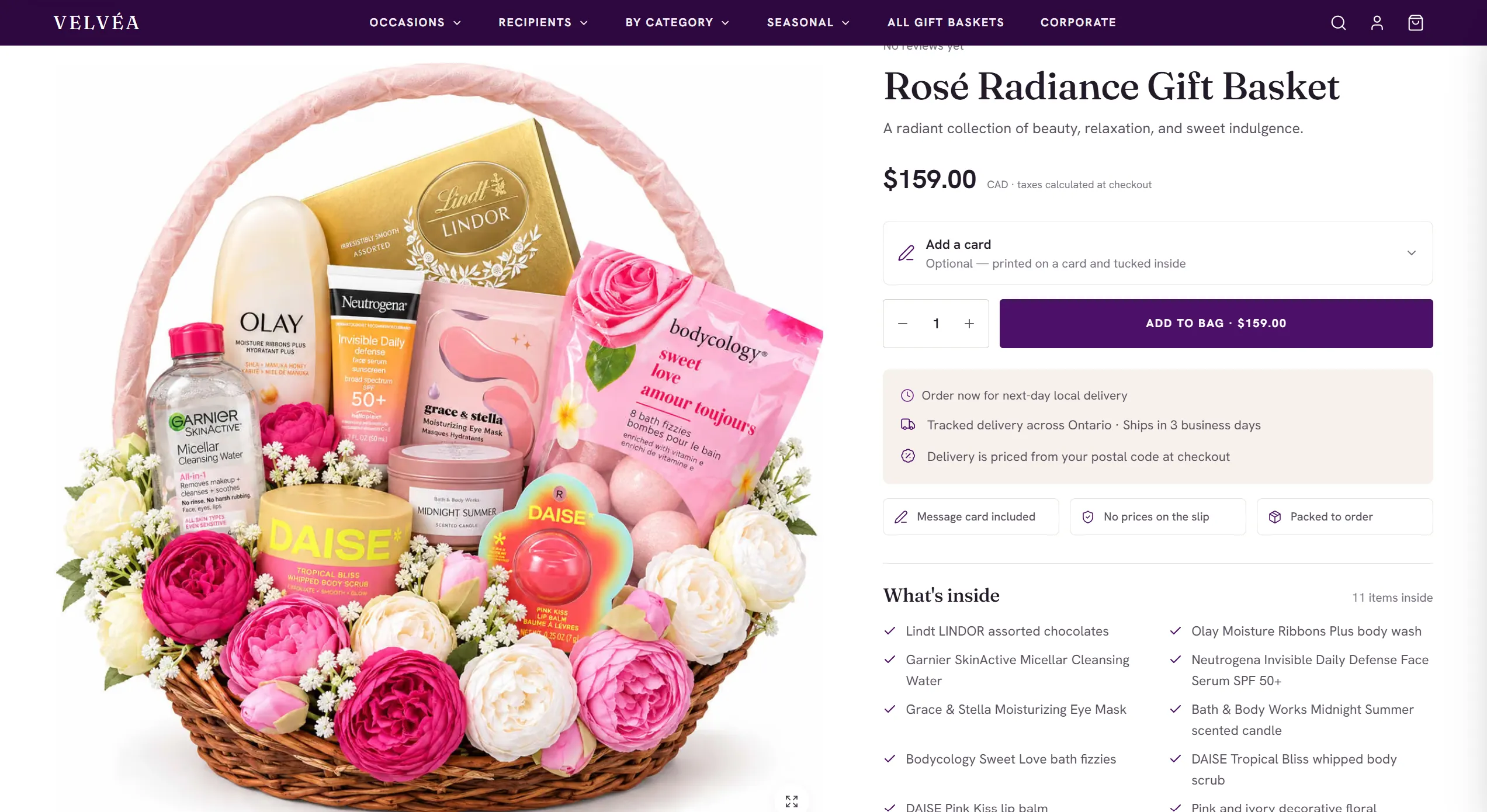
- Timing: next-day local delivery and tracked shipping across Ontario, stated on the product itself, with same-day delivery where the city allows it.
- Contents: a written list, item by item. The Rosé Radiance basket says it holds eleven things and names them, from the Lindt chocolates to the eye mask.
- Cost: the price is in Canadian dollars, and the page says delivery is priced from the postal code. Checkout shows the exact fee as soon as the postal code is entered, before payment.
- Discretion: a message card is included, and the packing slip carries no prices.
The written contents list does a second job. An AI assistant asked for "a self-care gift basket under $200 in Mississauga" can only recommend a basket whose contents and price it can read. A photo gives it neither. Every product page also carries product markup with its price and availability, so search engines read the same facts the shopper sees.
A page for every way people shop for a gift
People don't search for "gift baskets" in general. They search for a sympathy basket, a gift for new parents or a thank-you for a client. So the store has a real page, with its own address and title, for each of 15 occasions, 8 kinds of recipient and 7 categories.
The alternative, one catalogue page with filters, is the most common way online stores make their best pages invisible. We covered why in if your filters aren't URLs, nobody can find them.
The opposite mistake is letting every filter combination become a page. Sorting by price or filtering by a price range creates near-duplicates nobody searches for. On Velvéa those views point search engines back to the clean page, and the site's own search results stay out of Google entirely. The pages that should rank get the attention, and the rest consolidate into them.
Delivery is the product, so every city gets a page
Gift searches are city searches: "gift basket delivery Brampton", "same-day hamper Toronto". A shop that names its cities one by one is answering them. Velvéa has a delivery hub and a page for each of the eleven cities it reaches by its own team:
| Area | Service |
|---|---|
| Mississauga | Same-day if ordered by 4 p.m., from $9.99 |
| Toronto, Brampton, Oakville, Milton, Vaughan, Markham, Richmond Hill, Burlington, Georgetown, Bolton | Same-day if ordered by 1 p.m., from $14.99 |
| Durham Region and north York Region | Next-day, $19.99 |
| The rest of Ontario | Tracked courier |
These aren't one template with the city name swapped in. Each city page has its own introduction, the neighbourhoods served, the postal codes covered and answers to that city's delivery questions. Pages built from a template with only the name changed are the kind Google treats as doorway pages.
The more important detail is where the numbers come from. The fee and cutoff on each city page are read from the same delivery zones that checkout uses to charge the customer. When the owner changes a fee or moves a postal code into a different zone in the admin panel, the city page updates too. The marketing copy can't promise one thing while checkout charges another, which is a common way for a delivery business to earn its first complaint.
Everything on the site has to be true
A new business has no reputation to absorb a broken promise. So a large share of the launch work was making sure nothing on the site claimed something that wasn't so. A few examples of what we caught and fixed:
- Social links that didn't exist. The store template linked to Facebook, Pinterest and TikTok accounts that had been guessed, not created. They also appeared in the business details sent to search engines. Only Instagram exists, so only Instagram is linked, and a test stops guessed links from coming back.
- A paused feature still in the FAQ. The build-your-own-basket tool is switched off until it has real stock behind it, but the FAQ still invited people to use it. The FAQ answer now follows the same switch as the feature, so they can't disagree.
- "Handwritten" cards that would be printed. When the owner decided to print card messages, we changed the wording everywhere it appeared, in both languages and in the terms.
- Pickup that sounded like a shop. Studio pickup is real but by appointment, so every mention says so. Nobody turns up expecting a storefront.
The same discipline applies to what search engines and AI tools read. The store's llms.txt gives assistants a plain summary: online-only, studio pickup by appointment, no alcohol, which cities get which delivery. An early version said the FAQ covered allergens and substitutions. It didn't, so we corrected it.
French as real pages, not a toggle
An Ontario gift shop has French-speaking customers, and the people buying for them often search in
French. So the French store lives at its own addresses under /fr, with its own titles and
descriptions, and both versions are
linked to each other
so Google knows which is which.
The rule we built in: a French page is only offered to search engines once its content is actually in French. A product or guide whose French text is still a copy of the English stays live for anyone who switches language, but it's kept out of search and isn't paired with the English page. Partial French can't leak into Google looking like a badly translated site. Checkout text is covered by a test that fails if any French string is missing or empty.
Kept out of Google until it was ready
The store was built in public on its real domain, which meant unfinished product pages could have been crawled and indexed before launch. We put the whole storefront behind a single switch. While it was off, every page told search engines not to index it and the sitemap was empty. Crawling stayed allowed so search engines could actually read that instruction.
When the owner confirmed the catalogue was ready, the switch went on and the full sitemap was submitted in Search Console the same week. Before and after, we checked the live headers, not just the page code, to confirm what search engines were really being told.
The Business Profile and measurement from day one
Velvéa has no walk-in shop, but free pickup by appointment is in-person contact with customers, which is what a Google Business Profile needs. So it has a service-area profile with the studio address hidden and its delivery areas listed. We matched its name, phone number and website to the site, so the map listing and the store agree. It was verified on September 26.
Search Console and Bing Webmaster Tools were verified at launch with the sitemap submitted, and GA4 runs with Google's consent mode: analytics cookies are only set once a visitor accepts, and advertising signals stay off. That means we can watch how Google picks up a brand-new domain instead of guessing. It's also why this post has no traffic numbers yet. The site opened to search in late September, and a few weeks of data on a new domain doesn't tell you much. We'll write about the results when there are results worth reporting.
The Business Profile mistakes we see most often were avoided here by setting it up alongside the site, not months after.
The parts customers don't see
- A Stripe checkout with provincial tax, customer accounts with order history and discount codes.
- An admin panel where the owner runs products, photos, orders, reviews, delivery zones, corporate enquiries and gift guides without a developer.
- A separate path for corporate buyers. Someone ordering thirty baskets for thirty addresses needs something different from someone sending one to their mother. The corporate page offers volume pricing from 10 baskets, delivery to every address on a list, one point of contact and a quote within one business day.
- Abandoned-checkout reminders. One email per abandoned order, sent while the customer may still want the gift, with a working unsubscribe link and the business details Canada's anti-spam law requires.
- Spam protection on every public form, and more than 140 automated tests covering checkout maths, delivery rules, search markup and translations.
What we deliberately left for later
Launching well also meant choosing what not to launch:
- Gift cards are built into the design but paused until both issuing and redeeming them work end to end.
- The build-your-own-basket tool waits for real stock, photos and prices behind it.
- Google Merchant Center, which puts products into Shopping results, waits until there are real orders and the product claims behind it are confirmed. Its requirements reward accuracy, and a feed built on guesses is worse than no feed.
Each of these was a decision made with the owner, written down, and is waiting on a condition rather than being forgotten.
If you're opening an online store
The lessons from Velvéa carry over to almost any new shop:
| Decision | What to make sure of |
|---|---|
| Product pages | They answer the buyer's real questions in order, in text, not just photos |
| Categories | Every way people shop has its own page; filters and sorts don't |
| Delivery | Fees and cutoffs on the site come from the same data checkout charges |
| Copy | Every sentence is something the business will honour, including templates |
| Languages | Translated pages are real pages; untranslated ones stay out of search |
| Launch | Unfinished pages are kept out of Google until they're ready |
| Measurement | Search Console, analytics and the Business Profile are live on launch day |
If you're planning an online store, see our e-commerce development service, read the full Velvéa case study, or book a call to talk it through.
Frequently asked
How does a brand-new online store get found on Google?
Without domain history or reviews to lean on, it has to win on structure. Give every way people shop its own page (by occasion, recipient or category), give every city you deliver to its own page with real fees and cutoffs, and put prices and product details in text and product markup that search engines and AI assistants can read. Set up Search Console and a Google Business Profile on launch day so you can watch how Google picks the site up.
Should an Ontario online store have a French version?
If you sell to French-speaking customers, yes, but build it as real French pages at their own addresses, such as /fr, and only send the ones that are actually translated to Google. Velvéa's untranslated French pages are kept out of search instead of showing English copy under a French label.
Can an online-only business have a Google Business Profile?
Only if it has in-person contact with customers. Velvéa has no walk-in shop, but customers can collect orders from its Mississauga studio by appointment, so it runs a service-area profile with the address hidden and the cities it delivers to listed instead.
How long did it take to build Velvéa's store?
Development started on September 6, 2026, and the full catalogue opened to search engines in the third week of September. That covered the store, the admin panel, English and French, the delivery pages, and the search and analytics setup. Speed came from deciding the delivery rules, policies and page structure early, not from cutting them.
Sources
- Velvéa gift baskets, Velvéa
- Velvéa delivery areas, Velvéa
- Tell Google about localized versions of your page, Google Search Central
- Block search indexing with noindex, Google Search Central
- Consolidate duplicate URLs, Google Search Central
- Merchant listing structured data, Google Search Central
Filed under