The furnace fails at eleven at night, and your website is the shortlist
HVAC & Home Services: web design, development, and search visibility from a team in Mississauga working across Canada and the US.
Home services demand does not arrive gently. It arrives on a phone, in a hurry, from somebody who is already cold or already flooding, and who is going to try two or three names before somebody picks up. Everything on this page is about being one of those names and answering the only question that matters before they leave the page.
The problem this sector actually has
Three things make this sector different from ordinary local search. Demand is weather-driven, so the months when you most want to rank are the months it is hardest to move, and the work has to be done in the shoulder season. The search itself is almost never a comparison: it is a shortlist of two or three, assembled by a map pack or by an assistant asked who to call, which means visibility is nearly the whole funnel. And most operators run several trades under one roof, which is where the websites usually break. Five trades sharing one services page compete with each other for every result, and none of them wins the specific search a homeowner actually types.
Who this is for
- HVAC companies whose phone rings on the first cold snap and then goes quiet
- Multi-trade operators running plumbing, electrical, heating or roofing crews from one brand
- Contractors whose Google Business Profile ranks but whose website converts nobody
- Anyone buying emergency clicks at seasonal rates and landing them on a generic homepage
What we build
- A page per trade and per area served, instead of five trades sharing one
- Response window and coverage stated above the fold, not buried in a form
- Reviews and warranty terms as readable evidence, tagged to the trade they belong to
What the engagement covers
One page per trade, and per area you actually cover
A furnace repair search and a drain search are different jobs with different urgency, and a combined services page answers neither. Each trade states its own work, coverage and response window on its own page. Same for the municipalities you serve, where the coverage is genuinely different rather than a place name swapped in.
Availability answered above the fold
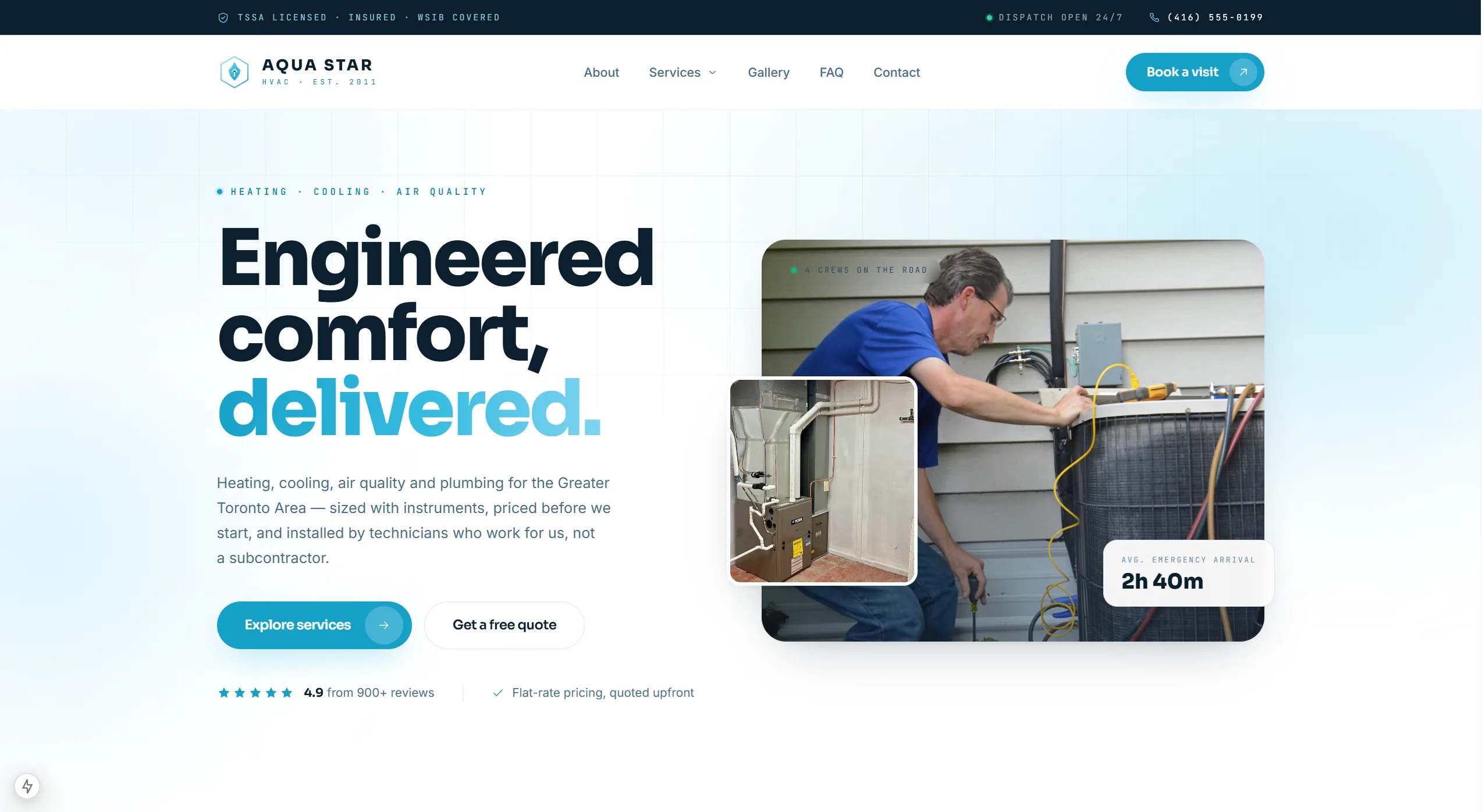
The visitor has one question and it is not about your history since 1987. Response window, hours, and whether you are taking emergency calls tonight belong in the first screen, phrased as a commitment rather than a badge.
Local search and the map pack
Service-area business setup, categories that do not dilute each other, and the Business Profile work that decides whether you appear in the three results a panicking homeowner actually sees. Most of this sits outside your website and it is usually where the ranking is lost.
Being the name an assistant gives
Asking an assistant for an emergency plumber in your city is now an ordinary way to find one, and the answer is assembled from your profile, your reviews and whatever your site states as extractable text. Response times written as sentences, service areas named, trades listed separately: that is the material it can quote.
Reviews as evidence, not decoration
A star average in a footer proves nothing. Reviews pulled in with the trade each one relates to and the platform it came from read as evidence a homeowner can check, and they are the single strongest signal in a category people are nervous about buying in.
Paid media that respects the season
Emergency clicks are expensive and they spike with the weather. That is a case for tight geography, hours-of-day scheduling, and landing pages per trade rather than one homepage absorbing every campaign, which is how most of this budget gets wasted.
Built for this sector
Questions this sector asks first
We run five trades. Should that be one website or five?
One site, with a real page per trade. Five sites means paying for five and splitting your authority five ways. One page listing five trades means every specific search lands somewhere generic. The structure that works is a single brand with a page per trade and a page per area where the coverage genuinely differs, all feeding one booking flow.
Our Google listing ranks fine. Why does the website matter?
Because the listing gets you onto the shortlist and the website decides whether you get the call. It is also half of what an assistant reads when somebody asks it who to call, and the half you control. A profile that ranks against a site that states nothing about response times or coverage is a lead you paid for and handed back.
When should we start, given the season?
In the shoulder months, because search work takes weeks to land and the cold snap does not wait for it. Starting in the first week of a heatwave or a freeze means paying for ads at peak rates while the organic work catches up. Starting in spring or early autumn means the rankings are already there when the weather turns.
Do you work with home services companies outside the GTA?
Yes. Our multi-trade work runs from Mississauga out across the GTA and also outside Ontario, and the structure travels because the problem does not change with the postcode: several trades, several municipalities, and a customer who needs an answer now. What changes per market is the competition and the seasonality, and those go into the plan rather than the template.